Think & Discuss
Quick Check
Inquiry Task
Scoring points: (1) Able to identify that the target of this statement is the assumption that "Homo sapiens is inherently central / is the pinnacle of evolution," rather than a denial of specific human capabilities; (2) Able to cite evidence from this chapter showing that humans long remained in the middle of the food chain, subsisting by gathering, hunting small animals, and scavenging carrion, only rising to the top about 100,000 years ago; (3) Able to explain that treating position as a historical outcome rather than a starting point is meant to raise the genuine question of "why did Homo sapiens prevail"; (4) Able to distinguish source statements (such as "Homo sapiens began creating complex cultural structures about 70,000 years ago") from the author's judgments (such as "having only one human species left is the anomaly"). Answers that merely express agreement or disagreement without reasoning should be considered insufficiently argued.
Examples of feasible verification directions: (1) Examine fossil and site evidence for multiple human species coexisting in the same period, to see whether the time span of multi-species coexistence holds up; (2) Verify when and how humans rose to the top of the food chain—for example, the timing of evidence for large-game hunting, and whether this conclusion is disputed among different researchers. Scoring points: The proposed directions must be testable through observation or literature, and must specify which claim of this chapter they are expected to support or weaken—not merely offer a vague "read more books."
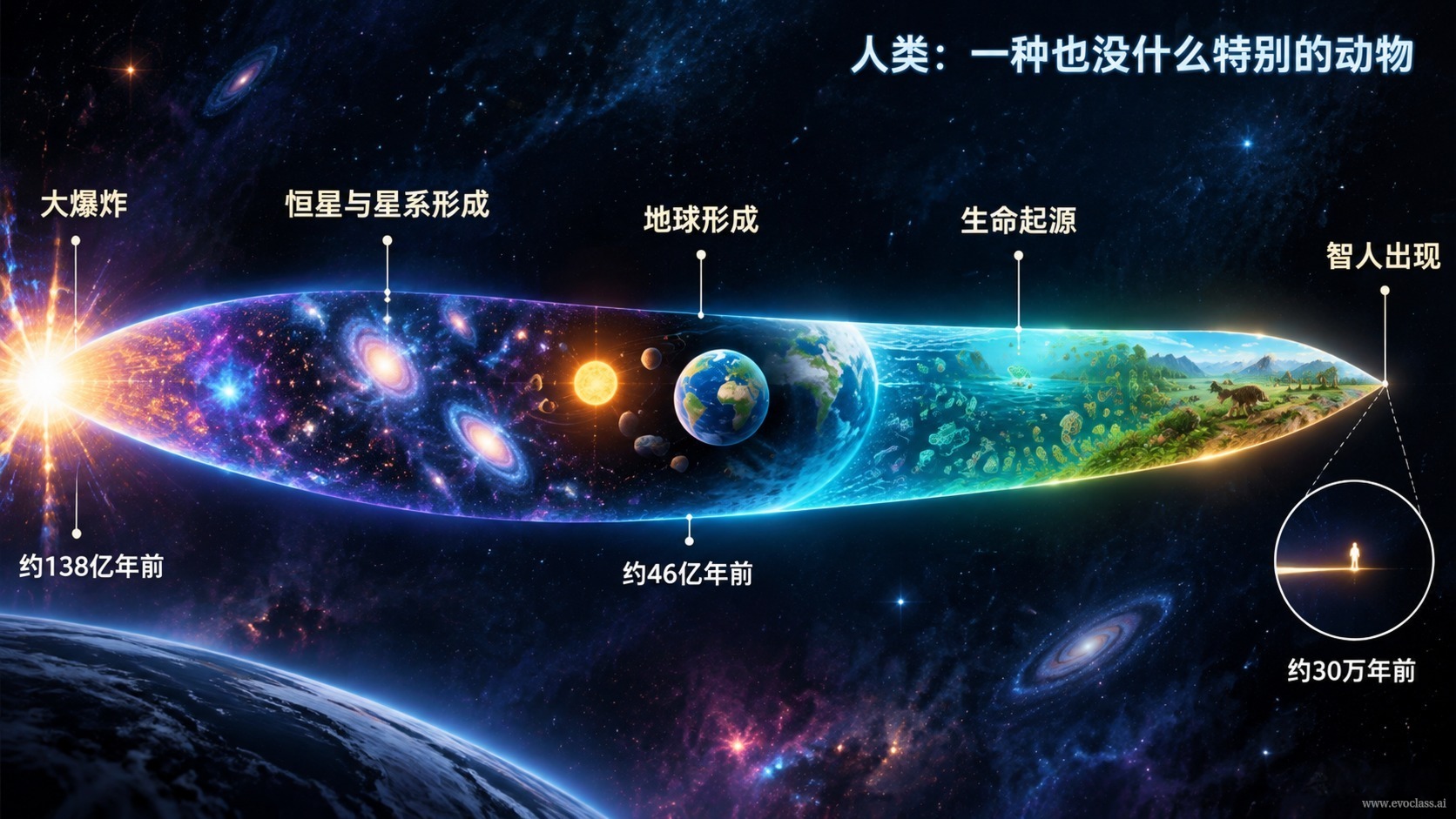
This chapter opens not with a conclusion but with a set of coordinates: the universe took its present form of matter, energy, time, and space only after the Big Bang roughly 13.8 billion years ago; organisms appeared on Earth about 3.8 billion years ago; and only around 70,000 years ago did creatures belonging to the species Homo sapiens begin to create complex structures known as "culture." Harari then condenses this long thread into one uncomfortable sentence: Homo sapiens is, in fact, "an animal of no special consequence."
- About 13.8 billion years ago: After the Big Bang, matter, energy, time, and space took their present form.
- About 3.8 billion years ago: Molecules on Earth combined into "organisms," and the story of life began.
- About 2.5 million years ago: Animals very similar to modern humans appeared in Africa, yet they were unremarkable compared with other creatures sharing their habitat.
- About 70,000 years ago: The Cognitive Revolution set history in motion, and Homo sapiens began creating complex cultural structures.
The point of this list is not to memorize dates, but to see clearlyproportion: If the history of life's evolution is treated as a ruler, Homo sapiens occupies only a tiny sliver at the very end. "Appearing very late" and "being inherently special" are two different things, and misreading the former as the latter is precisely the assumption this chapter sets out to dismantle.
Harari reminds readers to distinguish two often-confused terms:Homo sapiens(Homo sapiens) is only one species within the genus Homo, whilehumansbroadly refers to all members of the genus Homo. In the past, multiple species of Homo coexisted—Neanderthals, Homo erectus, Homo soloensis, Homo floresiensis, Denisovans, and others; only around the last ten thousand years did Homo sapiens become the sole surviving human species on Earth.
| Common Assumption | This Chapter's Description |
|---|---|
| Human species form a straight line: Homo habilis became Homo erectus, and Homo erectus became us | Multiple species coexisted and evolved independently over long periods, not as a sequential relay |
| Only one human species can exist on Earth at any given time | From about 2 million to about 10,000 years ago, multiple human species coexisted—at least six different kinds of humans |
| Today's "only one human species" is a natural, taken-for-granted norm | According to this chapter's judgment, this "only one left" is the anomaly |
Here it is necessary to distinguish fact from interpretation: the coexistence of multiple human fossils from the same period is evidence provided by the archaeological record; while "the linear evolution model is a common misconception" and "having only one species left is the anomaly" are judgments the author of this chapter puts forward based on that evidence, which readers can continue to test with their own questions.
Placing humans back into the history of life does not amount to denying human capabilities. This chapter is not saying that Homo sapiens has no strengths; rather, it refuses to presuppose that Homo sapiens is the pinnacle of evolution or the natural center of history. In fact, features such as a larger brain, bipedal walking, and the use of fire did not allow humans to dominate the Earth for over 2 million years: early humans had to avoid large predators and subsisted mainly by gathering plants, digging for insects, and hunting small animals—even following lions, hyenas, and other carnivores to scavenge carrion, using stone tools to crack open bones and suck out the marrow.
According to this chapter, humans remained stable in the middle of the food chain for a long time; only about 400,000 years ago did a few human species begin regularly hunting large game, and only with the rise of Homo sapiens about 100,000 years ago did humans leap to the top of the food chain. This leap came too hastily—the ecosystem had no time to develop checks and balances, and humans themselves were somewhat at a loss. Therefore, "humans later became the ecological masters" is not the starting point of the story, but a result that needs to be explained.
The answer offered in the next chapter points to Homo sapiens' unique language. But before accepting that answer, one must first accept the premise here: Homo sapiens was originally just one of many species; why it prevailed is a genuine question, not something to be taken for granted.
Evolutionary Timeline Diagram: From the Big Bang to the Emergence of Homo SapiensObserve the evolutionary timeline diagram in the image, from the Big Bang to the emergence of Homo sapiens, and consider how it relates to "this lesson's entry point: the evolutionary timeline of the universe, Earth, and life."